Adjust selected colors with hue curves.
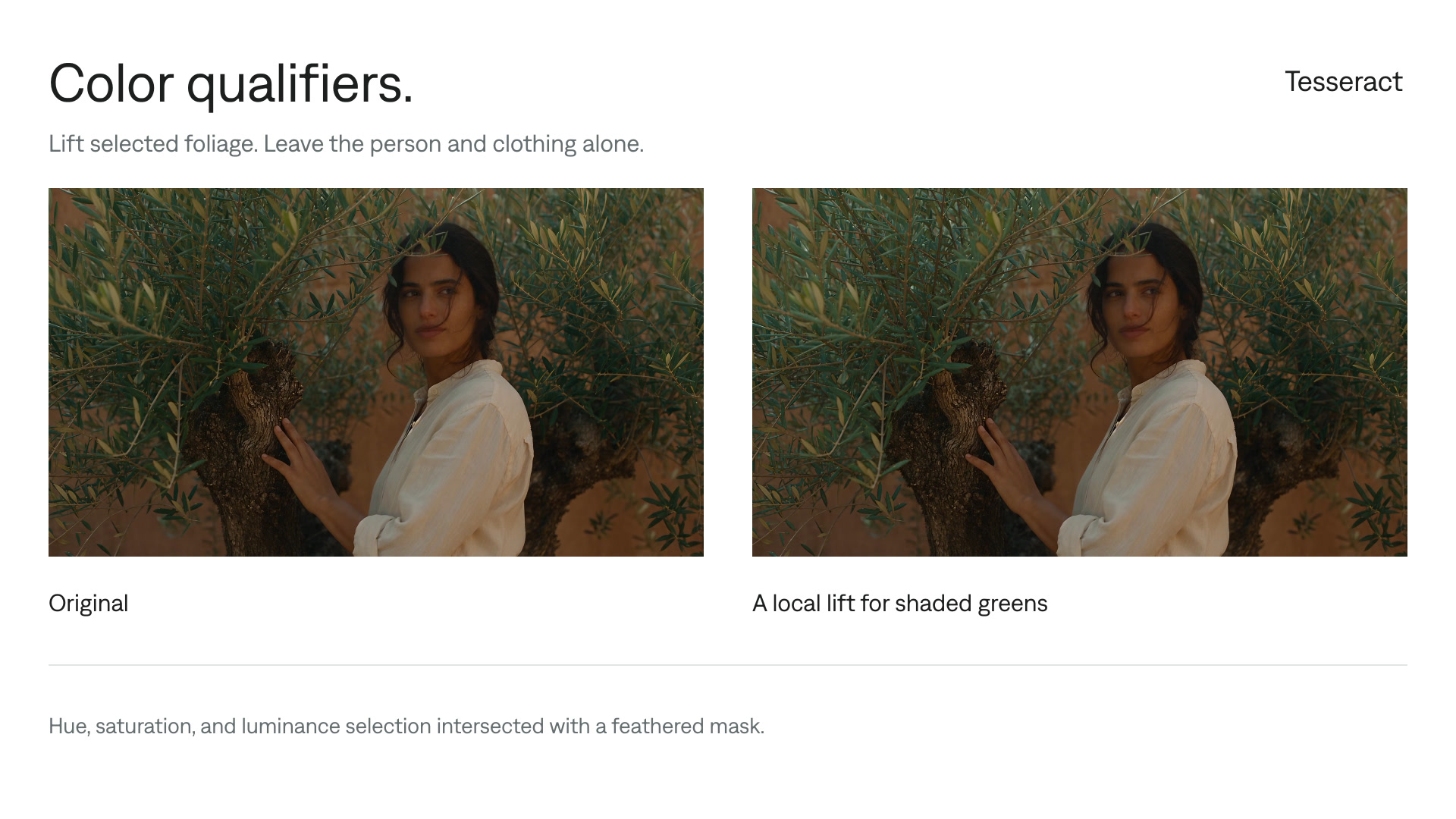
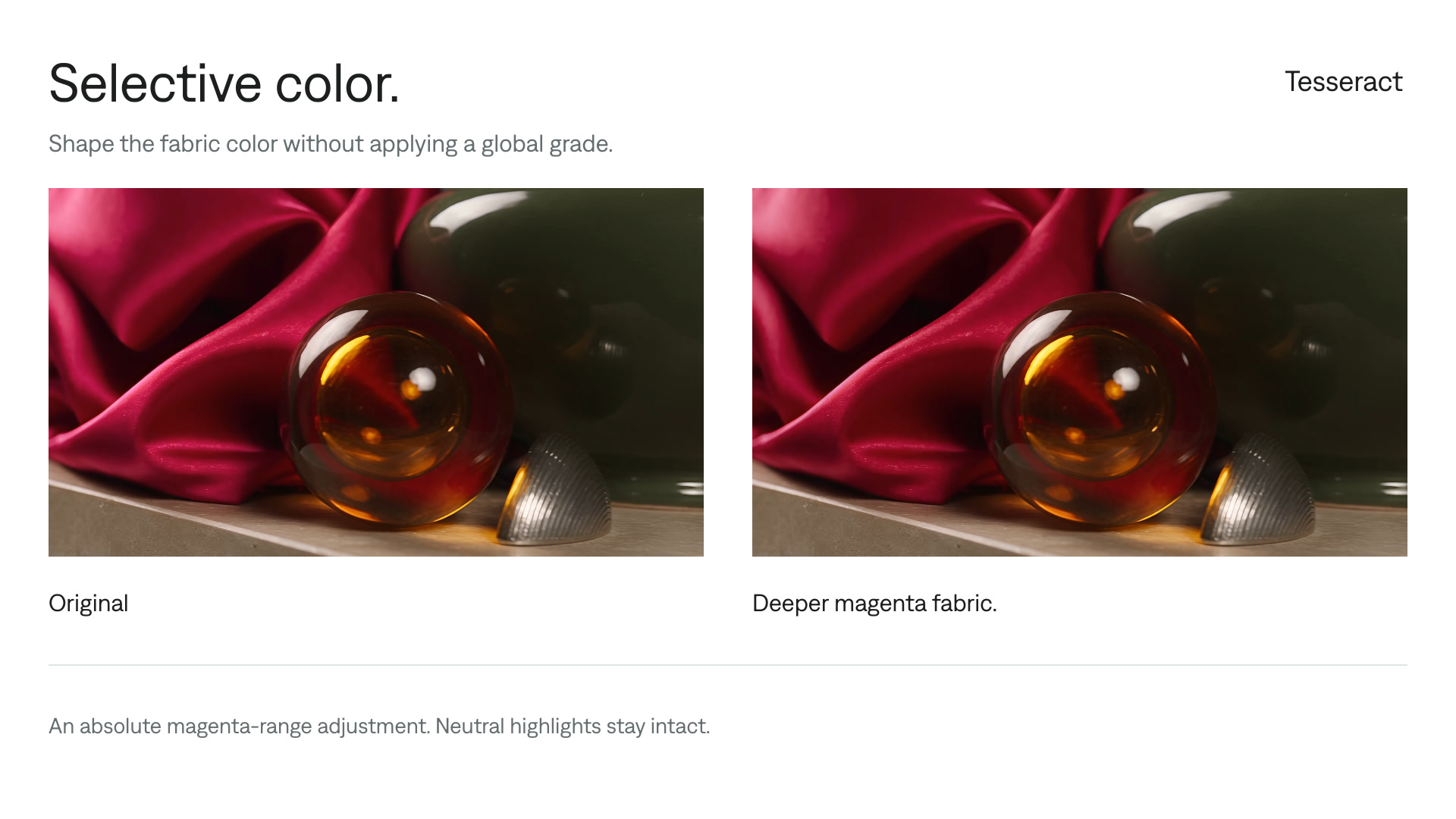
Change hue, saturation, or brightness within a selected color range. Reduce yellow in foliage, deepen a blue sky, or reduce saturation in highlights.
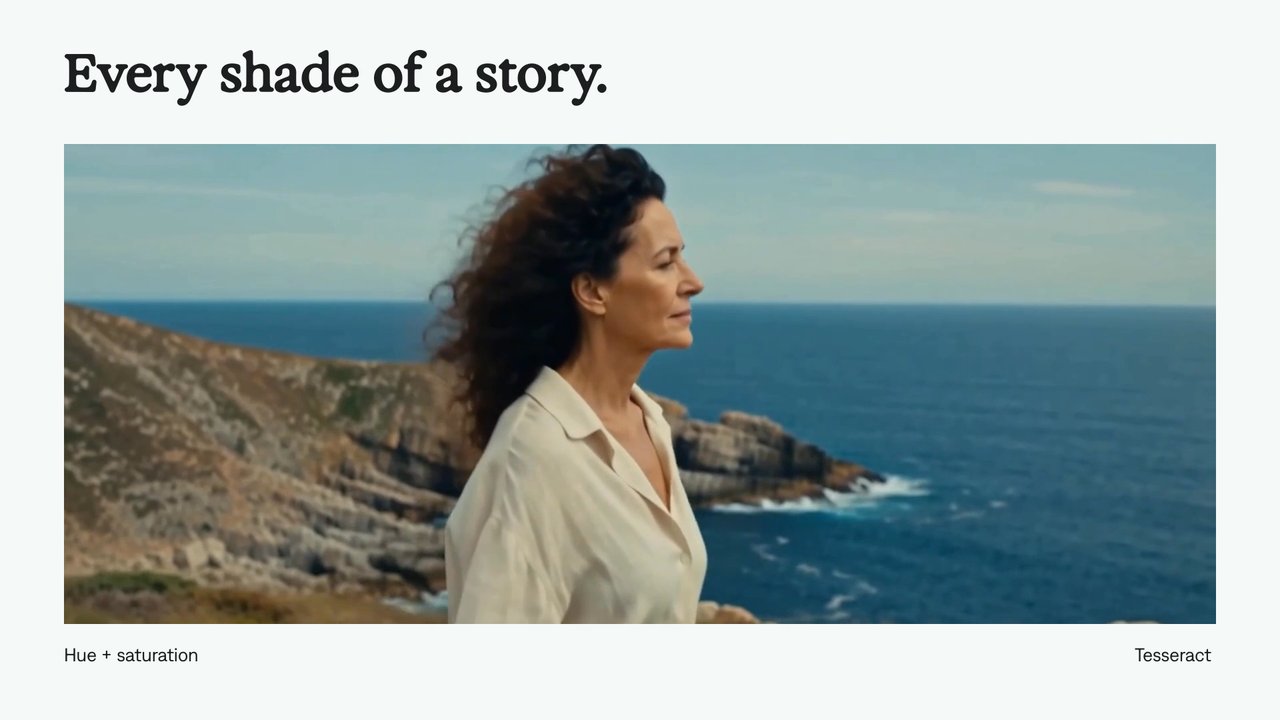
Sample footage generated with Seedance 2.5. The demonstrated correction is applied with native Tesseract controls.
Try it in your agent.
Use this prompt as a starting point. Review the result, then ask for the details you want to change.
A prompt to start from
Use Tesseract’s hue curves to make the greens in this garden portrait less yellow and slightly less saturated. Keep the skin tones close to their original colors. Show a before-and-after frame so I can check the edges of the affected range. Preserve the source and leave the hue curve controls editable.
New to Tesseract? Find the setup for your agent.
Keep control of the result.
- Hue range
- Choose the colors that the curve should affect.
- Hue, saturation, and luminance
- Shift a color, reduce its intensity, or change its brightness.
- Luminance and saturation ranges
- Control saturation according to how bright or saturated a pixel already is.
A few useful details.
Which hue curves are available?
Tesseract supports hue versus hue, hue versus saturation, hue versus luminance, luminance versus saturation, and saturation versus saturation.
Will a hue curve isolate an object?
It selects colors, not objects. Similar colors elsewhere can also change. Use a color qualifier with a spatial mask when you need to restrict a correction to a part of the image.
Can I revise the selected range after the first preview?
Yes. Ask your agent to narrow, widen, or soften the treatment by changing the editable curve points. The current curve point arrays are static rather than keyframe animated.
How do I try this with my agent?
Install or update Tesseract in a supported agent, attach your source files, and copy the prompt. Review the preview, then ask for the changes you want. The composition stays editable as you refine it.
Where does the video render?
Tesseract renders in the environment where your agent runs it, including supported local computers and hosted Linux environments. The engine is free; your agent’s subscription or usage costs are separate.
Put it to work in a video.
See how this tool fits into a complete, editable project.
Try these next.
Your next video, made with your agent.
Install Tesseract in your agent, bring a brief, and start creating.
Free on Mac, Windows, and Linux. Your agent’s costs are separate.
Read the prompt
Set up Tesseract by Mirage so you can create editable designs, edit videos, and make motion graphics in this agent’s environment. Read https://github.com/mirage-hq/Tesseract and check the requirements for this local or hosted environment. If it is supported, follow the official plugin or skills installation guide, use its required runtime version, verify the download checksum, and confirm a short preview renders correctly. Then ask what I want to make and which brand references or source assets I have. Keep the editable project and source assets with the finished render.